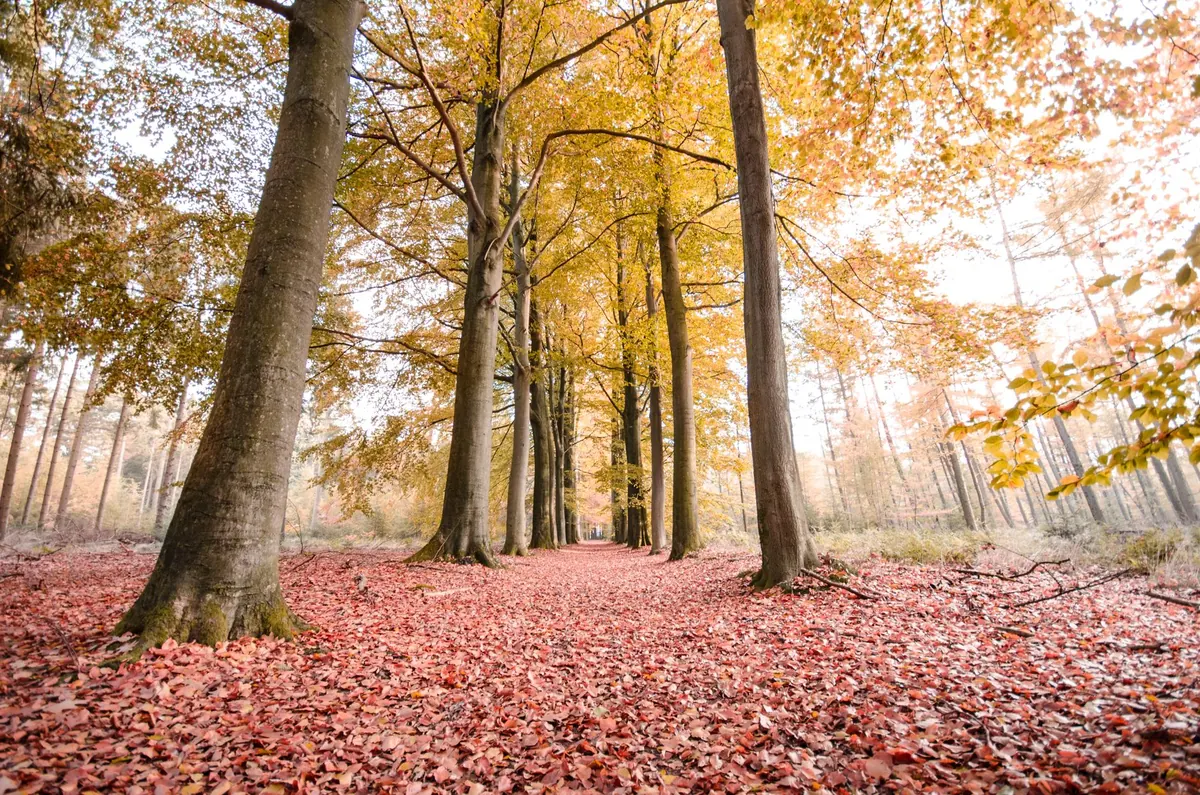
Autumn rewards a little planning. The woods shift from green to gold in a matter of weeks, hedgerows fill with hips and haws, and the light turns soft and low. But the days shrink quickly, and the paths that were dusty in August are slick by October. Get the timing and the kit right, and this becomes the best walking of the year.
Leaf colour is not random. Species change in a fairly reliable order, so you can pick a route to suit the week you happen to be free.
Late September belongs to the moors and the high ground. Bracken goes rust-coloured across heather hillsides, rowan berries glow red, and the first birches turn lemon-yellow. By early to mid October, ash, field maple and wild cherry are in on the act, with beech starting to bronze on chalk downland. Late October and November are the big weeks: beechwoods turn copper, oaks follow with a deeper russet, and larches — the one common British conifer that drops its needles — go butter-yellow on hillsides.
Two weather notes are worth remembering. A dry, bright September followed by cold, clear nights gives the richest colour. A mild, wet autumn produces something duller, and one gale can strip a wood in a day. Colour also arrives earlier the further north you are and the higher you walk, so a hillside wood can be a fortnight ahead of a sheltered valley a few miles away.
Low sun is the reason autumn photographs look better than summer ones, and it also makes walking more pleasant. The best light runs from sunrise to about two hours after, then again for the last two hours before sunset. In November the sun never climbs high enough to be harsh, so even midday is flattering.
Clear, still nights in autumn often produce mist in the valleys while the tops stay clear — the cold air drains downhill and sits there. Walking up through that and emerging into blue sky above a white sea is one of the season's quiet pleasures. It does mean visibility under trees can be poor, so carry a map and compass or a known route rather than trusting a half-remembered path.
Daylight is the thing people underestimate. Sunset moves earlier by a couple of minutes a day through September and faster once the clocks go back. Check the sunset time for where you are walking, not for where you live, and aim to be back at the car or the village half an hour before it.
That half-hour matters because sunset is not darkness. In a steep-sided valley or under a full canopy, the light is already going twenty to thirty minutes before the sky turns orange. Wet leaves, mist and a bit of mud will also slow you down noticeably, so a route that took four hours in July can take five in late October. Cutting your planned distance by a quarter or a third is a sensible habit rather than a timid one.
Tell someone your route and your expected finish time, and send a message when you are halfway round. Carry a small head torch even on a two-hour walk. A phone torch is better than nothing but leaves you one-handed on exactly the sort of ground where you need both.
In England and Wales, picking wild fruit, foliage, fungi and flowers for personal use is generally acceptable on land you have a lawful right to be on, but uprooting a plant needs the landowner's permission. Many sites go further: nature reserves, SSSIs, National Trust land and some woodlands ban foraging entirely, and in Scotland access rights are broader but commercial picking and certain sites are restricted. Check the rules for that specific place before you fill a bag.
Beyond permission, a few habits keep foraging good for everyone:
Good autumn targets include blackberries, sloes, rosehips, hazelnuts, sweet chestnuts, crab apples and rowan berries for jelly. If anyone feels unwell after eating something foraged, seek medical advice promptly and keep a sample of what was eaten.
Autumn ground is a different surface from summer ground. Chalk drains and stays firm. Clay does not, and a bridleway on clay can be a bog by early November. If you would rather not wade, aim for ridge paths, stony tracks, forestry roads and sandy heathland, and save the lowland loops for a frosty spell.
Falling leaves are the other hazard. They hide roots, stones and holes, and wet leaves on rock, limestone steps or wooden boardwalks are genuinely slippery. Descend slowly where the ground is covered, and take poles if you find steep, leaf-covered descents awkward.
Clean your boots before you head to the next wood. Mud carries plant disease and seeds, and a few minutes with a brush and water is a small price for not spreading it.
Five minutes at the kitchen table covers most of it. Check sunset time, wind and rain for your route; pick a walk that fits the daylight you actually have; tell someone where you are going; pack a torch, a hot drink and gloves. A flask weighs little and turns a cold bench with a view into the best half hour of the week.
Then walk with your eyes up. Autumn colour is short-lived and specific to each wood, each hillside, each valley. Match your plan to the light, take only what you need, and leave the mud where it belongs — on the outside of your boots.
Photo: ClickerHappy / Pexels
How to walk through British villages and farmland without causing offence: gates, livestock, driveways, rights of...
A first-timer's guide to the South West Coast Path: reading tides, staying safe near cliff edges, judging distances...
A practical guide to minimising your impact on the British countryside, covering path use, waste, wildlife...

Exploring paths, places, and stories of rural Britain..
